There’s no single HVAC system that is the ultimate solution for all commercial settings. Rather, the system’s adequacy is determined based on a number of factors specific to the building and operation in question.
That being said, several HVAC systems proved to be more effective than others (albeit slightly), which made them more popular for commercial applications. Let’s take a look at some of these options and see what are their pros and cons, so you can make an informed decision next time you’re choosing commercial HVAC equipment rental in San Diego.
What HVAC system is used in commercial buildings?
The four most popular types of commercial HVAC systems today are:
- Single-Split
- Multi-Split
- Variable Air Volume (VAV)
- Variable Refrigerant Flow (VRF)
 Single-Split Systems
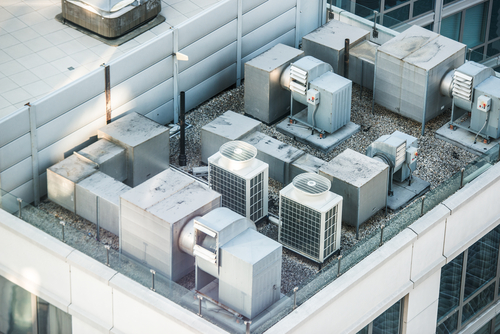 Single-Split Systems
Consisting of an indoor and outdoor unit, Single-Split systems equipped with everything necessary to effectively heat and cool individual areas within a building.
Pros:
- Cost-effective: Single-Split systems are relatively inexpensive to install and maintain. They’re also the cheapest option on this list.
- Easy to install: With only an outdoor and indoor unit, setup is simple and fast, typically completed within an hour or two.
- Independent: Since every Single-Split is a self-contained system, it allows for independent temperature control. In addition, if one unit fails, it won’t compromise the integrity of others.
Cons:
- Limited capacity: Single-Split systems are only suitable for smaller spaces, such as a single office or individual rooms.
- Limited & difficult scalability: Using single-splits for larger spaces requires the installation of multiple indoor and outdoor units. This consumes a lot of space and makes installation more time and labor-intensive, thereby quickly negating the biggest pro of this system: cost-effectiveness.
- Lower energy efficiency: Single-splits are generally less energy efficient than other options on this list, especially if multiple units are needed.
Multi-Split Systems
Similar to Single-Split, Multi-Split Systems also consist of indoor and outdoor units. The difference is that, with Multi-Split, a single outdoor unit can serve several indoor units, making it a much better option for buildings that require heating/cooling in multiple locations.
Pros:
- Space saving: A single outdoor unit makes it easier to cover the entire building without destroying its aesthetic appeal.
- Improved energy efficiency: Multi-Split systems are equipped with sensors that track temperature variations and adjust as necessary, lowering operating costs.
- Independent control: Although every indoor unit is connected to a single outdoor unit, they can be adjusted individually.
Cons:
- Complex installation: Multi-Split systems require more piping and wiring than Single-Split.
- Higher upfront costs: Requires a bigger initial investment than Single-Split systems.
- Interdependence: If an outdoor unit fails, all connected indoor units will be affected.
Variable Air Volume (VAV) Systems
Designed for large commercial spaces, VAV systems vary the airflow rate at a constant temperature to meet different heating and cooling requirements of different zones within the building.
Pros:
- Energy efficiency: Delivering adequate heating and cooling on demand reduces energy consumption.
- Zoning flexibility: VAV system design allows for precise temperature control in different zones.
- Build flexibility: There are many variations of VAV technologies, each suitable for different commercial applications.
Cons:
- System complexity: VAV systems are more demanding to design, install, and maintain.
- Significant initial investment: Due to the system’s complexity, VAV HVAC has a heftier upfront cost.
- Infrastructure requirements: VAV requires intricate ductwork, which can demand a lot of space and further increase time and labor requirements to install and maintain.
Variable Refrigerant Flow (VRF) Systems
A relatively recent arrival on the commercial HVAC scene, VRF Systems operate on a similar principle to Multi-Split but at a much larger scale.
Pros:
- Highly efficient: VRF can use either refrigerant or heat pumps to provide on-demand cooling and heating (depending on the chosen variant), which can significantly reduce operating costs.
- Zoning flexibility: VRF allows for precise temperature control within different areas of the facility.
- Scalability: Suitable for small and large applications, as well as for open areas and multiple smaller enclosed spaces.
Cons:
- Cost: Advanced technology and high-end components of this HVAC system demand a significant upfront investment.
- Complex installation & maintenance: The high-tech nature of VRF requires the expertise of certified technicians to properly install and maintain.
- Interdependence: Similarly to Multi-Split systems, if an outdoor unit malfunctions it will cause all indoor units to stop working.
Where can I find high-end commercial HVAC equipment rental near me in San Diego, Riverside, and Orange County?
 Where can I find high-end
 40+ years veterans of the HVAC rental industry, Aerco Systems, LLC delivers high-end heating and cooling solutions to commercial and industrial entities throughout San Diego, Riverside, and Orange Counties. With unparalleled expertise, swift response times, and a track record of excellence, we’re the prime choice of partner to take the efficiency and comfort of your operation to the next level. Get in touch with us today!